AI tools shape how prospects discover and shortlist brands. The organisations that appear accurately in those answers are the ones with clear, well-structured brand architecture. This article examines why brand architecture has become critical infrastructure for visibility and ROI, drawing on research and our work rebuilding EMCOR UK’s brand into four propositions that every stakeholder, human or AI, can understand.
The way people discover brands has fundamentally shifted. Your prospects are no longer clicking through pages of search results to compare options. Instead, they’re asking ChatGPT, Gemini or Perplexity for answers, and AI is making the choice for them.
And this is vitally import to you because
For B2B marketers, the implications are profound. When a potential client or customer asks an AI assistant to “find me XXX companies in London,” your brand needs to appear in that response and be accurately represented.
Organisations with clear brand architecture achieve 3.5 times more visibility than those without it. (Harvard Business School)
And different large language models rely on different data sources and retrieval methods. Without a structured approach to how your brand and its offerings are organised and communicated, AI systems struggle to understand and accurately represent your value proposition.
Make your brand work harder to deliver ROI
Companies with well-defined brand architectures deliver superior stock returns, according to research.
Brand architecture delivers even greater advantages in B2B contexts. This is because
- 20% uplift in EBIT margin which illustrates how brand equity translates into greater profitability. (Mckinsey)
- 30% of a company’s market value comes from brand and reputation, underscoring the investor relevance of cohesive architecture. (PWC)
- 97% of B2B decision-makers say branding influences awareness and 95% say it drives differentiation, which is critical in long, multi-stakeholder buying cycles. (LinkedIn)
- 92% of buyers start with a shortlist and 41% already have a preferred vendor. To succeed, vendors must focus on building brand recognition and trust early to ensure they are on the initial shortlist. (Forrester)
Clarity over complexity
Brand architecture typically follows one of five models.
- The branded house approach, used by companies like Apple, unifies all offerings under a single master brand identity.
- The sub-brand system references the master brand and adds a unique product or service name, like car manufacturers do eg: the Toyota portfolio includes the Toyota Prius, Toyota Corolla etc…
- The house of brands model keeps each brand entirely separate, as Unilever does with Dove and Persil.
- The endorsed brand model allows sub-brands independence whilst maintaining a connection to the parent company.
- The hybrid model blends these approaches based on specific business needs.
David Aaker, vice chairman of brand consulting firm Prophet, puts it simply: “The goal should be to have the fewest relevant brands needed to meet the business goals”. (Brand Portfolio Strategy, p.16) For most B2B service firms, it’s clarity over complexity every time.
Traditional SEO gave marketers clear metrics: rankings, impressions, click-through rates. AI-driven discovery operates differently. There’s no SERP position to track, no obvious signal that tells you whether ChatGPT is recommending your agency over competitors. Marketing teams are essentially blind to a channel that’s rapidly becoming dominant for discovery.
You can’t tell where your brand is being mentioned or how it’s being described across different AI platforms. You have very little insight into whether AI is reinforcing your intended positioning or subtly reshaping it.
The shift requires a fundamental rethink of brand visibility. Your brand needs to be understood by AI systems as a coherent entity with clear relationships between services, methodologies and client outcomes.
The EMCOR case study
Brand architecture is critical infrastructure. When your brand structure is clear, consistent and well-documented across all digital properties, AI models have the signal clarity they need to accurately represent you. When it’s muddled, AI fills the gaps with assumptions, or simply omits you from recommendations altogether.
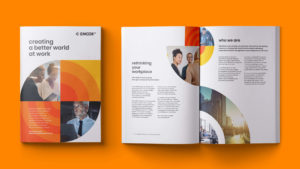
We worked with EMCOR UK, a £240 million facilities services business employing 4,000 people across 14 service lines, to address exactly this challenge. Their existing brand architecture had become too complex to communicate clearly to employees, customers or AI systems.
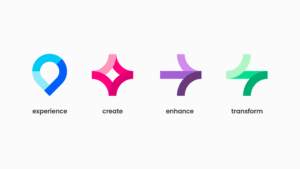
We created coherent brand architecture by delivering a new strategic brand proposition and refining their model of 14 different services into four relatable, memorable propositions: Experience, Create, Enhance and Transform. The result: a brand structure that every stakeholder, human or AI, can understand and represent accurately.
Business impact
Following the 2020 rebrand, EMCOR UK entered a period of accelerated growth in specialist facility services culminating in the sale of the business to OCS Group for £190 million in December 2025. The 2016–2020 period had been characterised by steady, operational performance; the post-rebrand years delivered the focused strategic growth that made the business an attractive acquisition at significant value.
Read the full case study
Get AI brand ready
Start by auditing your current brand architecture. Ask yourself
- Are the relationships between your parent brand, service lines and methodologies clear?
- Is this clarity reflected consistently across your website, LinkedIn presence and case studies?
- Most importantly, is it structured in ways that both humans and AI systems can parse and understand?
When every part of your brand portfolio has a clearly defined role and this structure is reflected consistently across all touchpoints, you create the conditions for both human understanding and AI comprehension.
For marketing leaders managing significant budgets and influencing major branding decisions, the calculus is straightforward. The brands that will maintain visibility in an AI-driven discovery landscape are those investing in clear, consistent brand architecture now.
How quickly can you audit, clarify and implement a structure that works for the AI systems rapidly becoming the primary interface between your brand and potential clients?
Audit your brand architecture – before AI does it for you
written by Sam Steele, Marketing and Communications Director, FCIM
Designhouse has partnered with FTSE 250 companies and global enterprises for over 50 years. We also work with start ups and scale ups to create brand identities that can grow with their business. If you’d like to discuss your brand challenges, we’re ready to talk.
Contact us