
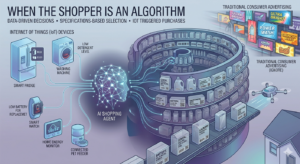

When The Shopper is an Algorithm
AI isn’t just changing how people shop. It is becoming the shopper of choice. In this post we’ll explain why that matters for your brand strategy.
Agentic commerce is when AI systems act on behalf of consumers to discover, evaluate, and purchase products. This is no longer a speculative scenario. It is taking shape now, in enterprise procurement tools, in consumer AI assistants, and in the broader infrastructure being built by the world’s largest technology companies.
If you’re responsible for brand strategy, the implications are significant. And they are arriving faster than a laser blink.
- 63% of global retailers agree that companies without AI agents will fall behind within two years*
- 58% believe AI agents will handle most customer interactions within five years*
- 60% of shoppers will use agentic AI to make purchases within the next 12 months**
sources: *Deloitte, **Harvard Business Review
Marketing managers must fundamentally rethink how brands, customers, and AI interact. For anyone responsible for brand, the implications are significant. Read on to understand why and what to do about it…
The AI Customer
To understand the stakes, you need to understand the process.
A personal AI agent operating on behalf of a consumer or a procurement team does not browse in the way a human does. It does not linger on a homepage, respond to a mood board, or a well-crafted headline. Instead, it queries structured data, cross-references criteria, weighs variables against stated preferences, and returns a shortlist or a decision.
|
|
Agentic commerce compresses days of human research, discovery, and comparison into instantaneous moments of evaluation. And this fundamentally changes how consumers allocate attention and make choices.
The New Criteria
The inputs AI agents use include
- product specifications
- pricing data
- availability
- reviews
- sustainability ratings
- structured brand data – machine-readable and consistently maintained across digital touchpoints
For example, I ask my AI agent find me options for a new TV. And then the AI agent retrieves and filters options, applying a weighting to the search based on both my stated and inferred priorities. As a result, it may present recommendations, or increasingly, simply complete the transaction. Alternatively, it may advise me to wait while it monitors price fluctuations, and then will automatically buy when the price drops. My input is minimal, the AI is doing all the leg work and, crucially a lot of the decision making.
Therefore, a brand whose product appears in the agentic search has won. The brand that does not is invisible, regardless of how compelling its creative work might be.
This shift is already happening. Adobe reported that AI-driven traffic to US retail sites jumped 670% year-on-year on Cyber Monday. OpenAI is partnering with Walmart, Shopify and payment platforms like Stripe. Perplexity is working with PayPal. And Google just released agentic checkout options. All of which means a bot will search, shop and ship your favourite goods to you, with minimal human input. (GeekWire)
In the B2B space, the pattern is equally pronounced. B2B buyers are increasingly using AI tools to conduct the early stages of vendor research. The tools filter out a significant proportion of the competitive set before the human even sees them.
If your brand is not structured, consistent, and legible to machine systems at that filtering stage, it may never reach the conversation at all.
Brand Identity that’s Visible to Both Computer and Human
Research from Pernod Ricard’s head of digital and design illustrates the risk acutely. When the company analysed how leading AI models represented its brands, they saw immediate issues of mislabelling and lack of visibility. LLM data was often incomplete or incorrect, with one popular model miscategorising an affordable mass-market whisky as a prestige product (Harvard Business Review). The consequences of that kind of misrepresentation, at scale and at speed, are considerable.
Most brand investment is built around human perception. Visual identity conveys authority. Tone of voice builds trust. Campaigns that create emotional connection. These things remain valuable, but now, they are only part of the picture.
The other part, the one that agentic systems respond to, is structural. It is the coherence and consistency of your
- product data
- brand architecture across digital channels
- accuracy and completeness of the information that AI systems read
The disciplines of brand management and data architecture are becoming inseparable.
The Brand Coherence Advantage
By 2030, the US consumer retail market alone could see up to $1 trillion in revenue generated by agentic commerce. Global projections are estimated at as much as $5 trillion. (Microsoft)
In this new world, organisations with strong, consistently maintained brand architecture have the advantage. A brand that means one thing clearly, that presents itself consistently across every channel and system, is easier for an AI agent to assess and surface. A brand with fragmented positioning, inconsistent written content, or poorly structured digital infrastructure presents as ambiguous. And ambiguity is completely incompatible with algorithmic decision-making.
The organisations that are best placed in an agentic commerce environment will be those that have invested in brand foundations:-
- clear positioning
- rigorous consistency
- well-structured brand architecture
Brand equity now needs to be read by the systems increasingly making decisions on behalf of your customers. If that’s not happening, your equity is quietly being eroded. Have a look at your brand architecture today and ask yourself
- is it coherent?
- is it consistent?
- is it searchable?
The brands best placed for this shift are already asking these questions. If you are not yet, now is a good time to start. We can help.