
Skcin
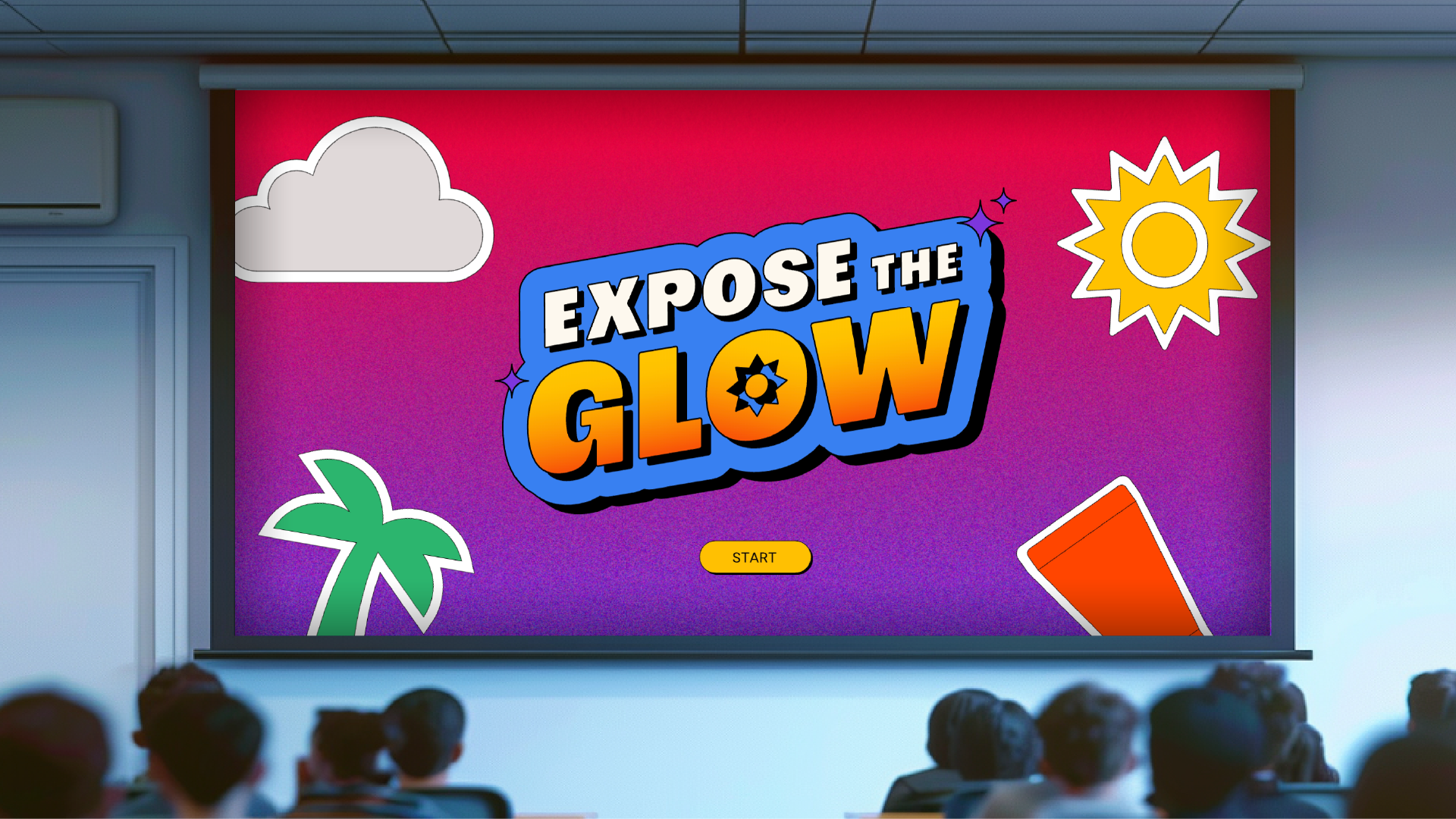
Skcin Expose the Glow is a campaign identity and interactive digital learning platform. Designed to teach secondary school students and young adults about the danger of sun exposure and UV safety. Engaging a generation that is consistently underserved by existing provision.
Making the connection
Skin cancer is the most common cancer in the UK, with melanoma among the leading cancers affecting young adults aged 15 to 34. Despite this, teenagers and young adults consistently deprioritise personal risk.
Awareness of UV harm is broadly acknowledged by this cohort. Which suggest that the problem is not ignorance but peer-pressure. In this age group's perma-tanned influencer landscape, tanning culture is not just normalised, it's idealised. The disconnect is that tanning remains normalised, algorithmically rewarded, and socially embedded in peer culture, particularly across TikTok and Instagram.
"The organisation required its first dedicated, scalable digital learning experience; one capable of evolving over time, capturing robust attitudinal data, and informing future policy and evaluation activity"
Targeting teens
Skcin has a well-established reputation in primary school education and professional training. A significant and repeatedly identified gap existed in secondary school and young adult provision.
The organisation required its first dedicated, scalable digital learning experience for this underserved audience; one capable of evolving over time, capturing robust attitudinal data, and informing future policy and evaluation activity.
The Skcin Expose the Glow campaign needed to deliver credible UV safety education to a digitally native audience. Specifically an audience who resists institutional messaging, responds to peer influence over authority and is acutely alert to content that patronises or lectures. To engage this audience requires a keen understanding of the audience's psychology.

The Approach
Audience Insights
Designhouse began with a strategic diagnosis of the audience, not the subject matter.
Discussions with the client, who work with this age group, identified three consistent behavioural drivers in the target cohort. These are, a strong orientation towards status and progression; a natural instinct to interrogate and debunk; and a sophisticated media literacy that made young people simultaneously susceptible to, and suspicious of, social feed content.
The strategic decision was to use these insights as assets, not obstacles. Therefore we built the campaign around those instincts rather than counter them.
The chosen creative direction, Expose the Glow, positioned teenagers as investigators rather than learners. Participants are presented with social media content drawn from typical TikTok and Instagram posts, including influencer posts, tanning routines, and sunbed advice, and asked to classify claims as myth or fact.
Flipping the script
The mechanism places the young person in the role of the expert. It draws on content they already encounter in their feeds. Asks direct questions and, therefore, requires active critical judgement rather than passive absorption.
The campaign name is deliberately double-edged: it signals both the exposure of a deceptive narrative and the cultural register of the audience it is speaking to.
Looks are everything
For this age group in particular, how something looks is incredibly important. Conspicuous clothing, grooming, footwear, accessories and allegiances function as plumage. Therefore the visual identity was developed to operate credibly inside the aesthetic world of the target audience.
The Y2K-influenced design language, bold chromatic palette, and interface conventions borrowed from social media platforms were deliberate choices. This ensures the campaign reads as culturally fluent from first contact. It is specifically not an institutional health communication dressed in a contemporary wrapper.
Kathryn Clifford, Co-founder of SKCIN described the campaign as
“bold, immersive and intentionally designed to meet young people in the digital spaces and visual culture they recognise and respond to every day”.
The Outcome
Optimised for delivery
The platform is optimised for classroom delivery in 16:9 format. This provides teachers with a structured, curriculum-compatible tool that requires no prior preparation.
A folder and case file motif runs through the UX, reinforcing the investigative narrative. The content has a tangible, tactile quality that works well at classroom scale.
Digital stickers, drawn from elements of the interaction and uploaded to GIPHY, allow Expose the Glow to extend beyond the classroom. This encourages the audience to continue spotting misinformation on social media and amongst peers.
Deliverables included
- Visual identity
- Interactive digital platform
- Data capture and evaluation framework
- Landing page
- Animated Gifs
Designed for ROI
Crucially, a data capture framework is built in, to measure knowledge, attitudes, behaviours, and intent to change across participating cohorts. That data capture is the foundation of the platform's long-term value. It allows Skcin to build an evidence base that informs future policy submissions, press activity, and, importantly, funder reporting. This data is what compounds the return on the initial investment with every school session delivered.
Young people in the 14 to 24 cohort are not uninformed about UV risk; they have simply formed an implicit judgement that the risk applies to other people, in other circumstances, at a later point in time. Closing the knowledge gap requires the audience to actively participate in knowledge generation, rather than being a passive recipient of messaging.
The design challenge Designhouse addressed for Skcin is structurally identical to challenges faced by any brand or organisation attempting to shift entrenched behaviour in a peer-influenced, algorithmically mediated culture.
The comprehensive human centred design approach is vital in this process. This is because, as Skcin co-founder Kathryn Clifford explained, "from the outset, Designhouse understood that this campaign could not look or feel like traditional health education if it was going to genuinely connect with young people”.
The process of agency, progression, and cultural recognition that makes Skcin Expose the Glow effective for sun safety is the same process that makes any sustained behaviour-change communication programme work.
See the work at Skcin
Talk to us about your brand
If you are weighing a brand investment against a specific commercial outcome, we would value the conversation.
Contact Jonti Davies, Client Services Director, at jonti.davies@designhouse.co.uk